

Why TrustUp
Straight-to-the-problem consulting.
Most companies do not need more noise. They need someone to find the constraint, name it clearly, and help the team fix it.
Clarity for growth. Structure for execution. Confidence for scale.
What we are not
We are not here to create more work around the work.
TrustUp helps founder-led and growth-stage companies solve the three problems that usually start slowing them down: revenue that does not move cleanly, leadership that depends too much on the founder, and trust that is not ready when someone asks for proof.
Most consulting looks useful in the meeting and disappears the moment the team returns to real life. The deck is polished. The language sounds strategic. The recommendations are broad enough to be safe. Then the company is left with the same problem, only now wrapped in a longer document.
That is not how TrustUp works.
We do not start with a framework for the sake of a framework. We start with the constraint. Where is momentum being lost? What is unclear? What is not owned? What cannot be proven? What is stopping the company from moving with confidence?
Then we build the smallest practical system that fixes the issue and can actually be run by the team.
No theatre. No bloated transformation. No abstract advice that nobody owns.
Why teams choose TrustUp
Because growth exposes the weak parts of the system.
A company can look successful and still be fragile underneath. There may be pipeline, but not enough conversion. A leadership team, but decisions still wait on the founder. Policies, but no evidence when someone asks.
We find the real constraint
We do not treat symptoms as strategy. If revenue is slow, we look at positioning, qualification, sales motion, partner contribution, and market response. If execution is messy, we look at priorities, ownership, decisions, and rhythm. If trust is weak, we look at obligations, controls, evidence, and owners. The point is simple: fix the thing that is actually limiting movement.
We build usable assets
The output is not just a recommendation. It is a working artifact: a commercial friction map, a sales story, a 30/60/90 plan, a leadership rhythm, an ownership map, an obligations register, a control plan, or a diligence-ready pack. The team leaves with something it can use.
We install a rhythm
A fix does not hold unless someone reviews it. Every engagement leaves behind a cadence: a weekly review, a dashboard, a decision log, a control review, or a clear owner for the next action. Progress becomes visible. Ownership becomes harder to avoid.
What makes us different
We work like operators, not spectators.
TrustUp is built for companies that need practical help, not theoretical commentary. We ask direct questions. We look at the evidence. We challenge vague answers. We help the team decide what matters now and what can wait.
- 01Constraint first
- We do not optimise around the edges while the main blocker stays untouched. Every engagement starts by identifying the lowest-scoring or highest-friction area.
- 02Evidence over opinion
- We prefer pipeline data, buyer conversations, decision logs, control evidence, and real examples over internal assumptions.
- 03Movement over motion
- Activity is not progress. We care about what changes: conversion, decision speed, ownership, readiness, and the ability to prove what the company says.
- 04Usable over performative
- A control people run beats a policy nobody opens. A decision rhythm that works beats a beautiful governance chart. A simple sales narrative used by the team beats a large messaging deck nobody remembers.
- 05Senior judgement
- We work with founder-level pressure, commercial reality, leadership complexity, and buyer scrutiny. The work is designed for teams that need decisions, not decoration.
- 06Systems that stay
- We leave behind tools, registers, dashboards, packs, rhythms, and owners. The engagement should make the company easier to run after we step out.
Where we help
Three systems decide whether a company scales cleanly.
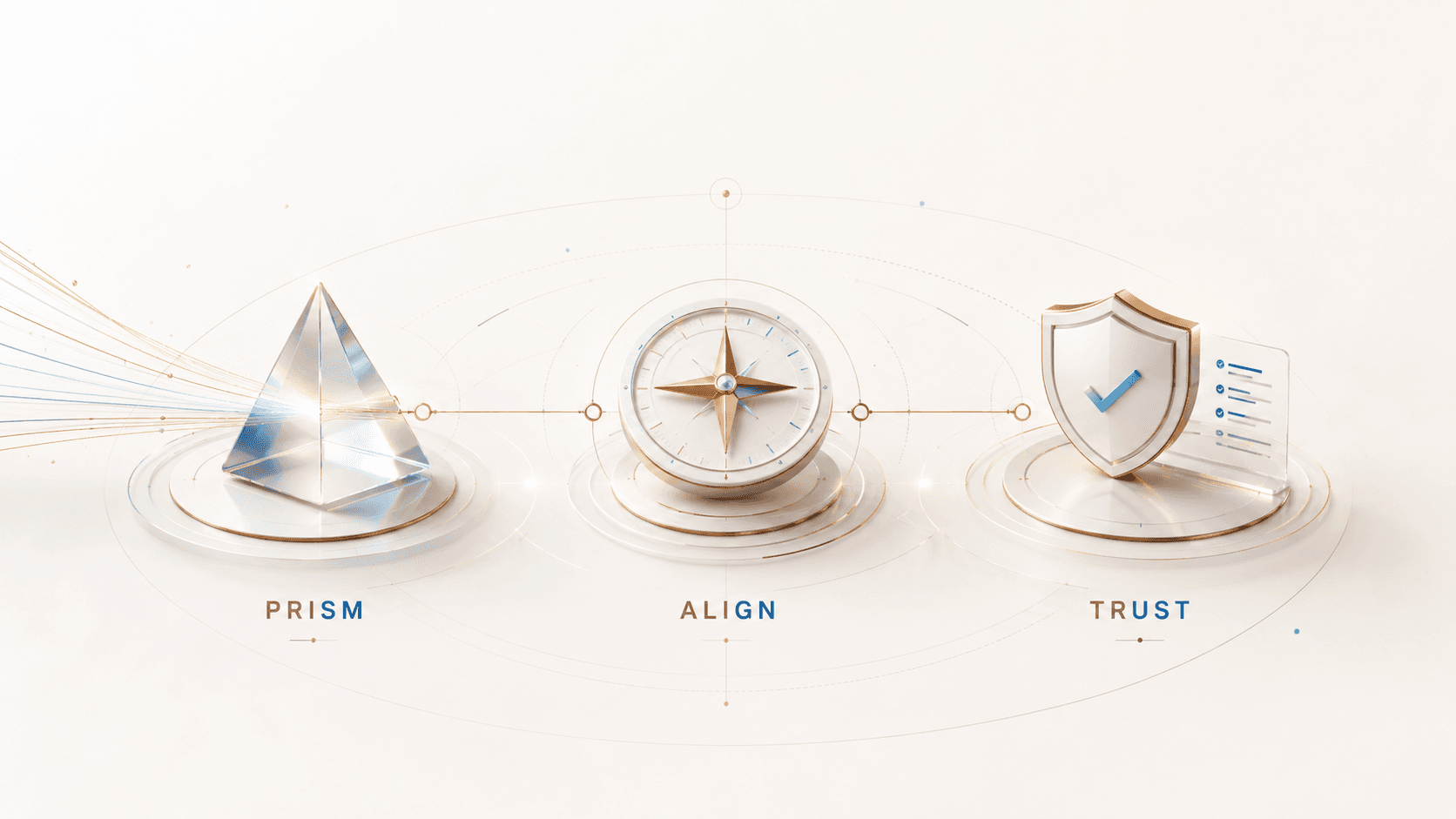
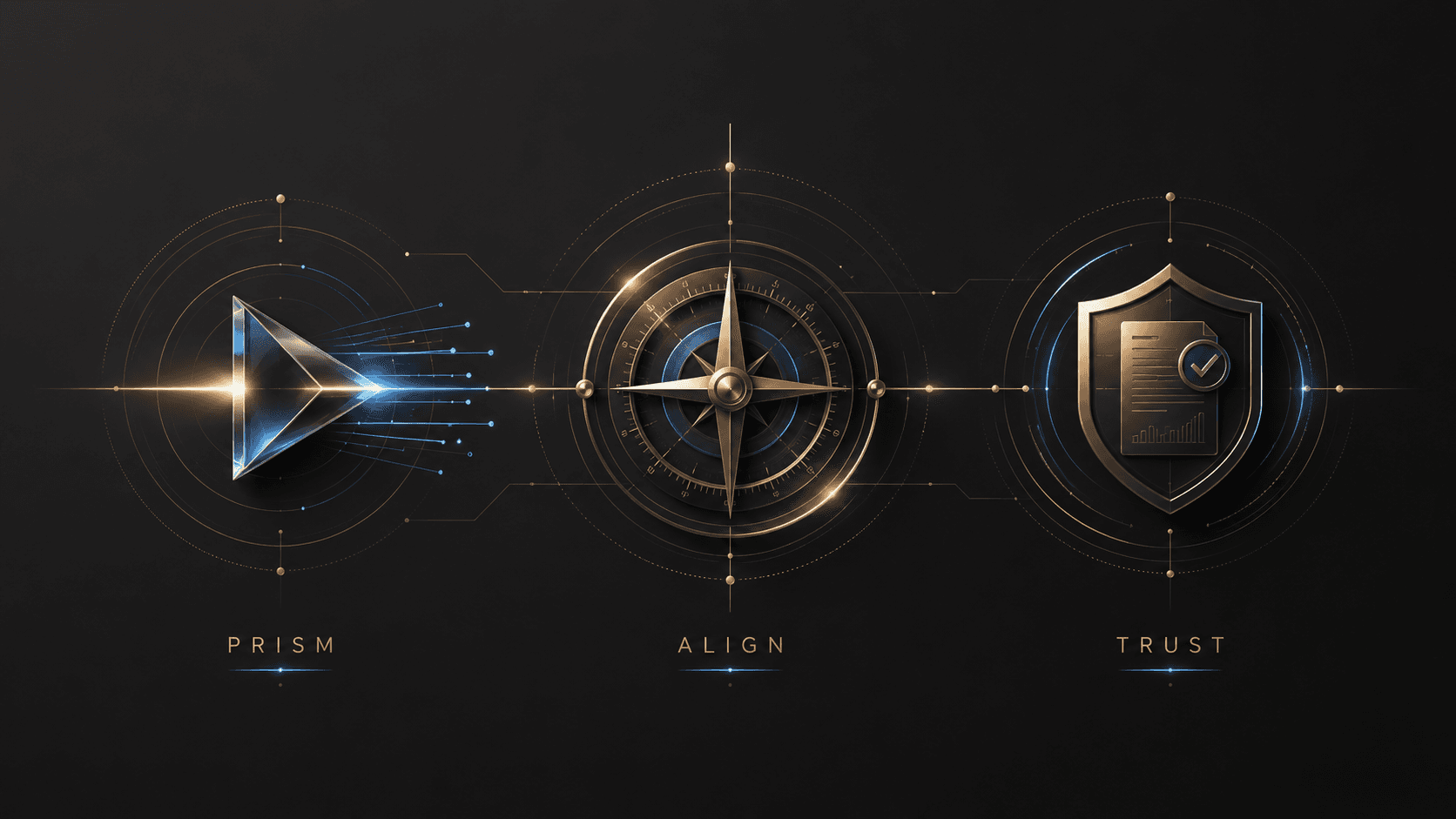
Commercial movement, leadership rhythm, and credibility, each with a methodology built to fix it.
The TrustUp way
Simple sequence. Serious work.
We keep the work focused because complexity is usually part of the problem.
- 01
Diagnose
We start with the current reality. What is happening? Where does work stall? What is being assumed? What is not measured? What cannot be shown? The goal is not to admire the problem. The goal is to find the constraint.
- 02
Decide
We help the leadership team make the trade-off. What gets fixed first? What waits? Who owns it? What does done look like? A decision that is not owned is not a decision.
- 03
Build
We build the practical asset the company needs: a plan, dashboard, register, scorecard, sales story, control map, evidence pack, or operating rhythm. The work has to survive contact with Monday morning.
- 04
Install
We help the team run the system. That means owners, cadence, review points, and a clear way to see whether the change is working. A system without rhythm decays.
- 05
Handover
We leave the company with the asset, the rhythm, and the next review point. The team should know what to run, who owns it, and what evidence proves progress.
What it feels like to work with us
Direct conversations. Practical outputs. Clear ownership.
You should expect us to ask what is really happening, not just what is in the deck. You should expect us to challenge broad statements, and to push for owners, dates, evidence, and decisions.
The work is collaborative, but not passive. We work with your team, not around it.
- Clear diagnosis
- We identify the friction and show why it matters.
- Plain language
- We avoid inflated consulting language and write in terms your team can act on.
- Real deliverables
- Each stage produces something usable.
- Decision pressure
- We help the team make the trade-offs that usually get postponed.
- Evidence
- Every recommendation should connect to a fact, pattern, record, owner, or measurable signal.
- Handover
- The company keeps the operating asset and the rhythm to maintain it.
The standard behind the work
Every engagement must answer four questions.
Before we call something useful, it has to answer:
- 01What problem does this solve?
- 02Who owns the next action?
- 03What evidence supports the decision?
- 04What will show that progress is real?
If the answer is unclear, the work is not finished. That standard applies across PRISM, ALIGN, and TRUST. Different problems. Same discipline.
Find the constraint. Fix the system. Move with evidence.
Start with a diagnostic conversation. We will help you understand whether the pressure is commercial, operational, trust-related, or a combination, and where to start.
No long discovery theatre. No generic workshop. Just a clear first conversation about the problem, the pressure, and the system behind it.