

Compliance & Readiness Methodology
Build credibility before you are forced to prove it.
TRUST puts privacy, risk, and control foundations in place early, and proves they work when a regulator, auditor, investor, or enterprise buyer asks. The obligation, the control, the owner, the evidence: ready to produce.
What good looks like
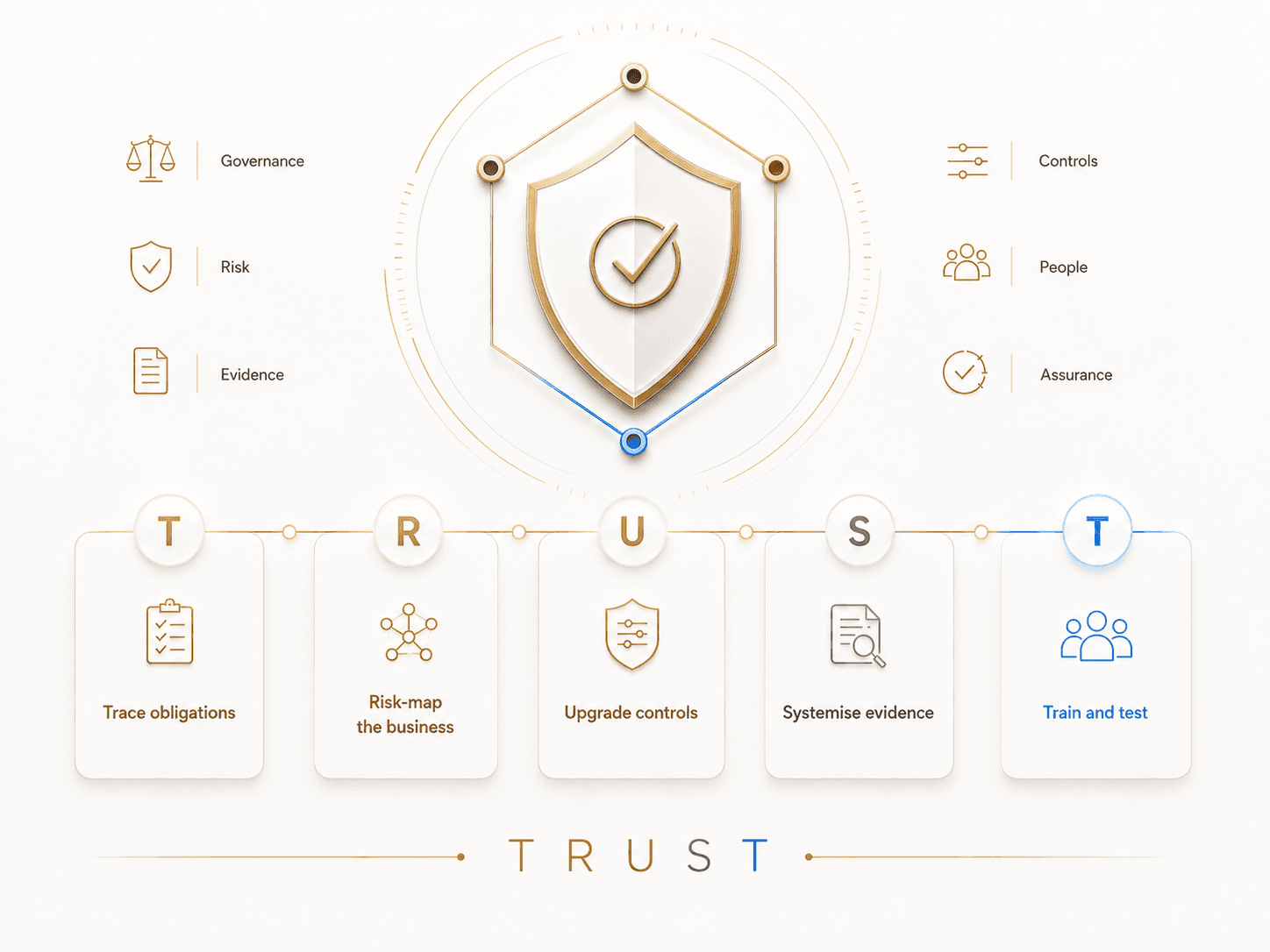
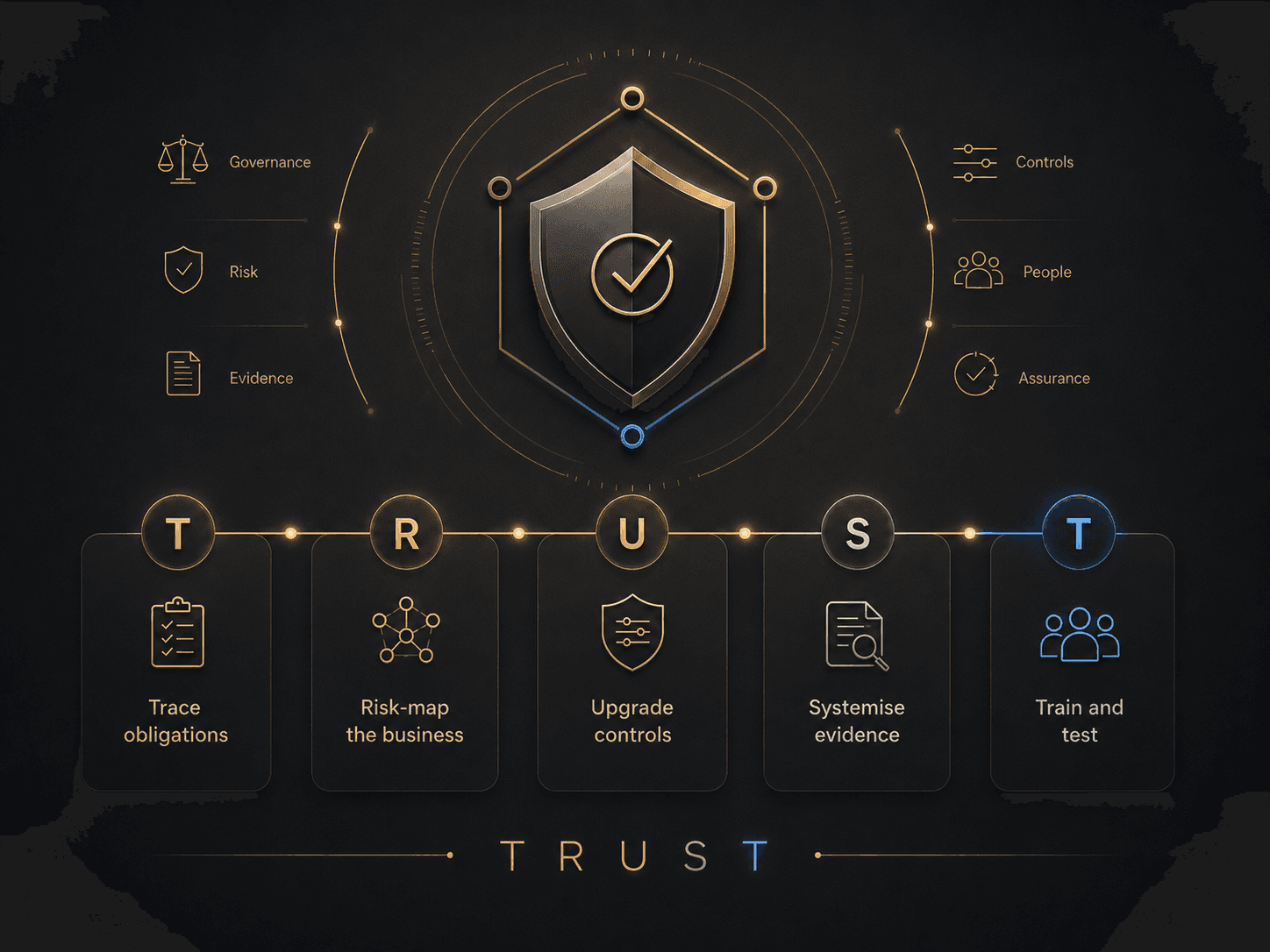
The six dimensions TRUST strengthens.
Readiness is not one thing. TRUST builds the six dimensions a regulator, auditor, investor, or enterprise buyer actually tests.
Governance
Clear ownership, decision rights, and policies people actually follow.
Risk
Exposure mapped and ranked, so the biggest gaps get closed first.
Evidence
Proof organised and locatable: a record, an owner, a date.
Controls
The minimum effective controls, sized to your stage, running in normal work.
People
Owners trained to run their controls, not just read a policy.
Assurance
Diligence-ready: answer a buyer, investor, or auditor on demand.
How TRUST is run
Three principles that keep the work pointed at real exposure.
Exposure first
Close the gap that would hurt most in a real review before improving anything else.
Evidence over assertion
Readiness is what the company can show: a named control, an owner, a record, a date.
Usable over performative
A control people run beats a binder nobody opens. Sized to the team, then tested.
Where we focus
Where TRUST goes to work.
TRUST is delivered across five service areas, engaged on their own or as a full readiness engagement.
Privacy & Risk Foundations
Map obligations and rank exposure before pressure arrives.
Governance Readiness
Clear ownership, decision rights, and controls that actually run.
Investor Readiness
A diligence-ready evidence pack you can produce on demand.
Policies & Controls
Lean, stage-appropriate policies the team actually follows.
Training & Design
Owners trained and controls tested under real requests.
Entry point
TRUST Readiness Diagnostic
A scored read of how ready the company is to prove its controls, answer buyer or investor scrutiny, and close the most important readiness gap first.
Best for: Companies facing enterprise security reviews, investor diligence, audit preparation, or rising privacy and risk scrutiny.
What you get
- Readiness score profile
- Binding exposure
- Priority gap map
- Recommended 30-day first move
Where are you now?
Find your situation, and the first move.
The TRUST Diagnostic scores five dimensions and names your binding exposure. Most companies recognise themselves in one of these.
Unmapped Obligations
Busy and probably careful, but no single view of what rules and commitments apply.
First move: build the Obligations Register and Applicability Map.
Hidden Exposure
You know roughly what applies, but no one has ranked where a weak or missing control would hurt.
First move: a control-gap risk assessment.
Paper Controls
Policies exist as documents, but the controls, owners, and workflows behind them are thin.
First move: design stage-appropriate controls and assign owners.
Evidence Scramble
Controls run, but proof is scattered across drives and inboxes, and a diligence request turns into a fire drill.
First move: build an evidence index and a diligence pack.
Shelfware Compliance
The documentation looks complete, but people don't use it and no one has tested it under a real request.
First move: install training, a scenario test, and a review rhythm.
Almost Audit-Ready
The trust foundations are solid, and one gap still limits readiness.
First move: targeted closure, not a broad reset.
Not sure which fits? The TRUST Diagnostic gives you a scored read and a recommended first move.
Request the TRUST DiagnosticWays to engage
Start where the pressure is.
TRUST runs as a single diagnostic, focused sprints on the gap that is binding (privacy and risk, controls and policies, or diligence readiness), a full 90-day readiness sprint, or an ongoing review retainer.
Readiness Diagnostic
About 1 weekBest for: Companies facing buyer or investor scrutiny for the first time
Output: Score profile, binding exposure, archetype, and 30-day first move.
90-Day Readiness Sprint
About 12 weeksBest for: Companies that need to be diligence-ready
Output: Obligations register, risk map, controls, lean policies, evidence index, diligence pack, and review rhythm.
Privacy & Risk Foundations Sprint
3-4 weeksBest for: Companies starting from a blank page
Output: Obligations register and ranked risk and gap register.
Controls & Policies Sprint
3-4 weeksBest for: Companies with controls that exist only on paper
Output: Control register, lean policy set, and uplift plan.
Diligence Readiness Sprint
2-3 weeksBest for: Companies in or near a deal, raise, or review
Output: Evidence index and diligence-ready pack.
Readiness Review Retainer
MonthlyBest for: Companies that have completed a sprint
Output: Quarterly reviews, evidence upkeep, and support through audits or buyer reviews.
TRUST prepares a company and organises its evidence. By itself it does not make a company “GDPR compliant,” “SOC 2 compliant,” or “ISO certified.” Certification and legal conclusions rest with auditors, certification bodies, and the company's own counsel; TrustUp's templates are working tools, not legal advice.

When someone asks for proof
Trust you can prove, not just promise.
TRUST puts the obligation, the control, the owner, and the evidence in place, so readiness is something you produce on demand, not scramble for.
The first 90 days
What changes in 90 days
- 30
First 30 days
Trace and Risk-map
Obligations mapped and risks ranked.
- 60
By 60 days
Upgrade
Priority controls designed and owned.
- 90
By 90 days
Systemise and Train
Evidence organised and key controls tested.
Questions & objections
Common questions.
Does TRUST make us SOC 2, GDPR, or ISO compliant?
No. TRUST prepares readiness and organises evidence. Certification and legal conclusions rest with auditors, certification bodies, and qualified counsel.
Is this what Vanta or Drata does?
Those tools monitor and track controls. TRUST helps design the controls, assign owners, organise evidence, and make the system usable.
Is this legal advice?
No. TrustUp templates are working tools, not legal advice. Legal interpretation should be reviewed by qualified counsel.
We are not regulated. Do we need this?
Maybe. Readiness is not only about regulators. Enterprise buyers, investors, and partners often ask for proof even when a company is not formally regulated.
Build credibility before the pressure arrives.
Start with a Readiness Diagnostic: a clear read on your binding exposure and the gap to close first.